If I ask where ramen came from, most people would answer Japan. If I ask who is best known for the moonwalk, people would say Michael Jackson. And they wouldn’t be wrong. One is so distinctly Japanese it feels inseparable from the country; the other is so iconic it helped define a legendary career.
But ramen came from China, and Michael Jackson wasn’t the first person to do the moonwalk on television.
I’m not saying ramen, in its modern form, came from China. What came from China was the idea — wheat noodles introduced from Guangdong province to port cities like Yokohama. Early on, it was even called shina soba, literally “Chinese noodles.”
The same thing happened with the moonwalk. It’s well documented that Jeffrey Daniel of Shalamar performed it on British television a year before Michael Jackson did. Jeffrey Daniel also taught the move to Michael. If you don’t know Jeffrey Daniel, it’s worth looking up his clips. His control is unreal. His influence didn’t stop there either — his movement later shaped artists like Ginuwine, though you can probably figure out which move on your own.
Why am I talking about ramen and Michael Jackson?
For one, Justin just learned the moonwalk and has been doing it all over the house.
Second, I’m still a bit high from Japan. I’ve been wanting to make a chicken-based soup noodle for a long time now.
And lastly, the world feels like it’s gone to shit — rising nationalism, tension everywhere.
A few weeks ago, I saw a message stuck to a bus stop. It read, “Refugees go home. You’re not welcome in Taiwan.” I ripped it off. Justin asked me why. I told him it was hateful.
Japan is often admired for how carefully it protects its culture and heritage. Yet one of the dishes most closely associated with Japan is rooted in something foreign. There’s a quiet irony there. The same way the greatest entertainer ever, with countless moves and even patents to his name, is forever associated with a move that wasn’t originally his.
Good artists copy. Great artists steal.
Japan is a great culinary artist. It took a bowl of noodles from China and made it its own. You would never confuse a bowl of Lanzhou lamian with a bowl of ramen. Visually, they live in completely different worlds.
Ivan Orkin once said he chose to focus on ramen because ramen has no rules.
And yet, while ramen doesn’t have strict rules in the way Italian carbonara does, it’s still defined by its construct. There’s soup, noodles, a protein, and add-ons — bamboo shoots, dried seaweed, whatever else fits. Innovation happens within that construct.
We also can’t talk about ramen without mentioning instant ramen and its creator, Momofuku Ando. Momofuku invented instant ramen, and later Cup Noodles. He inspired a billion-dollar global industry and changed how people eat around the world.
Momofuku Ando occupies a special place in Japan’s modern story. He’s widely recognized as one of the country’s greatest inventors — a figure so closely associated with postwar recovery and everyday life that he’s treated as unmistakably a Japanese hero.
He was born Go Pek-Hok (Wu Bai-fu) on March 5, 1910, in Chiayi, Taiwan. He was of ethnic Chinese descent and grew up under Japanese colonial rule. He didn’t travel to Japan for the first time until he was 23, in 1933.
Momofuku was an immigrant.
I’m not here to argue whether he was Taiwanese or Japanese. That’s not my place. What is undeniable is that he was an immigrant who contributed enormously to his adopted country.
When you do well, even societies that are traditionally closed off will eventually claim you as one of their own. Success has a way of smoothing borders.
When you don’t — or can’t — the story looks very different. Some immigrants, including refugees, are instead framed as burdens, accused of eroding a country’s moral or cultural fabric, regardless of whatever contributions they may make.
My father, after leaving the U.S., used to wear an American flag pin on his suit.
This was a country he never fully assimilated into. He never learned the language, never operated outside of Chinatowns. And yet, America gave him a chance at a life when he had run out of options.
He loved a country that didn’t accept him back then.
I’m also a product of the U.S. I’m often mistaken for an American. And while I’m culturally Americanized, I’m not American.
As a Taiwanese citizen, I meet the legal definition, but not always the cultural one.
Wherever I go, I struggle with fit and belonging.
Everywhere I visit now, when I talk to different people, I hear the same anxieties. That their country isn’t the same anymore. That migrants and refugees have changed it — too many people, arriving too fast.
There’s nothing inherently wrong with wanting to protect tradition and culture. But like a bowl of ramen, culture evolves. As long as the construct remains, there should be room for new ideas — and new people.
Because you never know when you might be turning away the next Momofuku Ando.
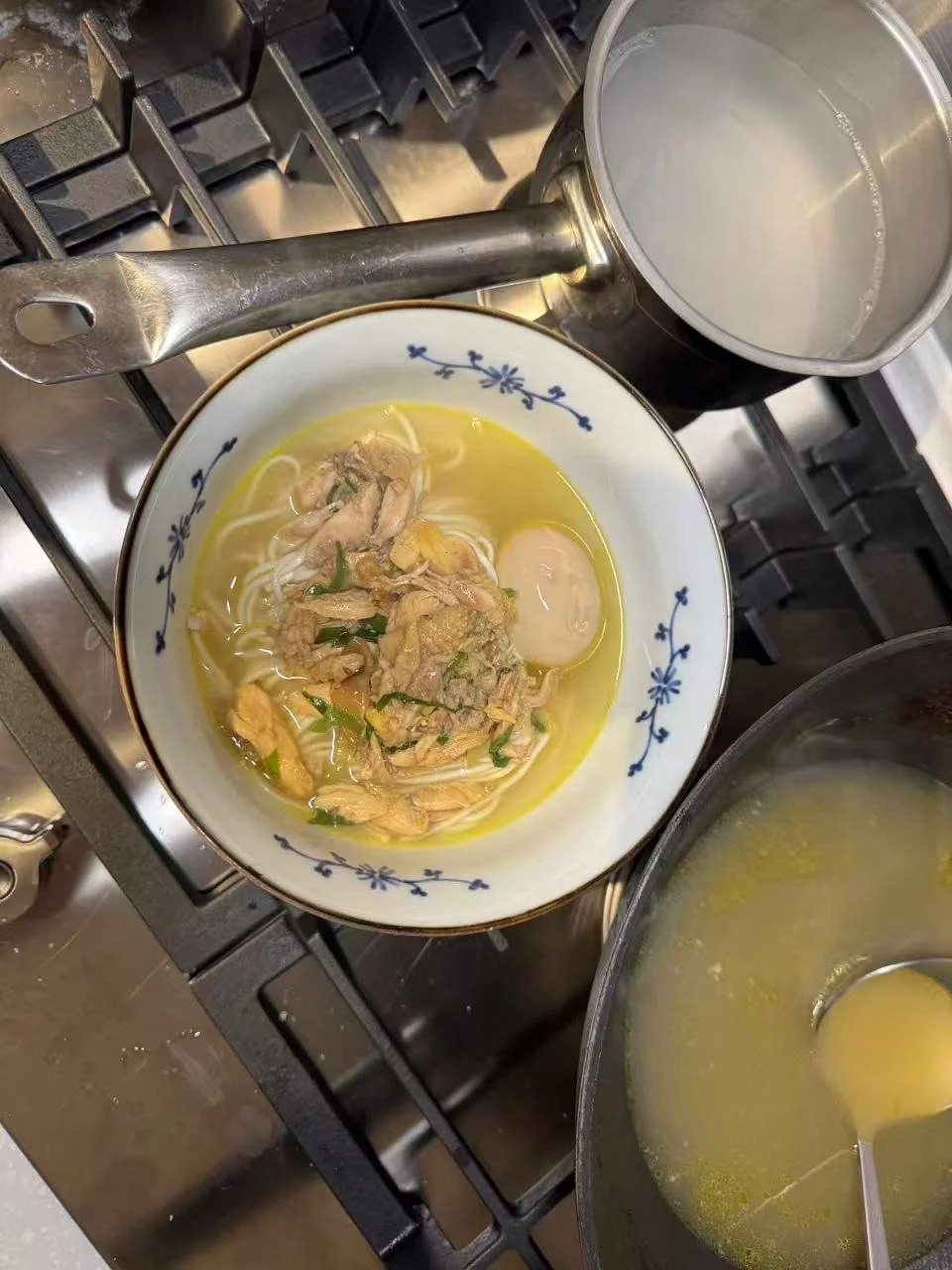
I made a chicken chintan noodle soup. I roasted a bunch of chicken wings for the soup, took the meat off the roasted bones and then stir fried with some teriyaki sauce, and then I topped off with soy braised egg from Costco. Not a bad cheat substitute for ramen!